
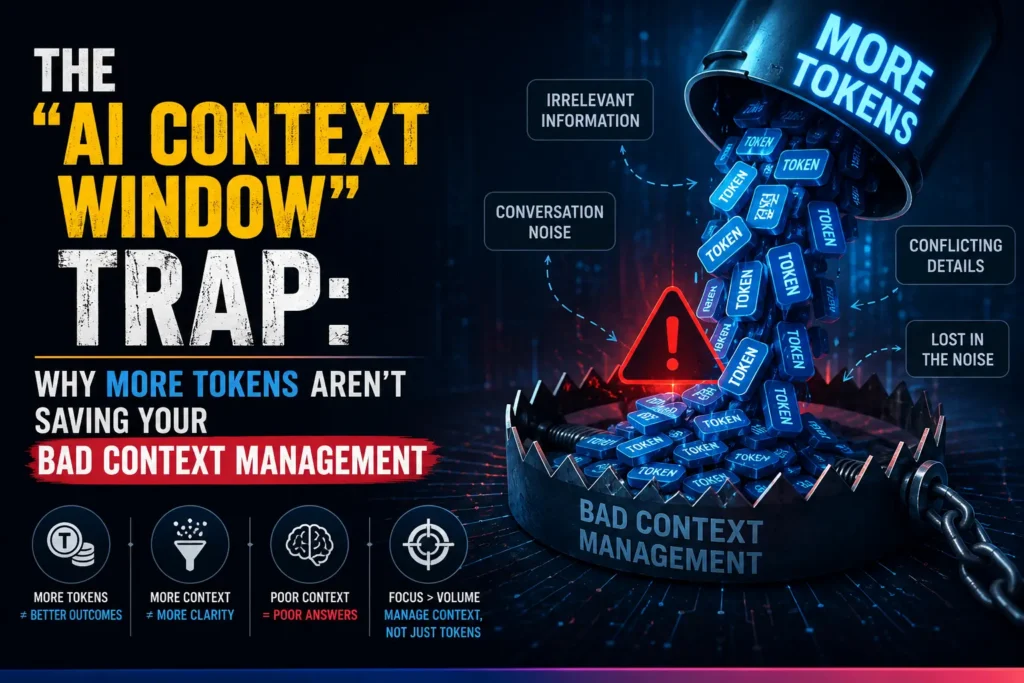
There is a running joke in production AI engineering right now: Your AI is charging you rent to re-read the exact same code every single day.
Every major frontier model vendor has spent the last year bragging about astronomical context windows. Between Claude’s 1M tokens, Gemini’s 2M+ window, and open-source giants like Llama 4 Scout pushing 10 million tokens, the collective industry sentiment was supposed to be: “The context problem is solved. Just dump the repo into the prompt and let the LLM figure it out.”
Except, if you look at the trace logs of teams actually running complex AI agents or autonomous developer loops in production, you’ll find a completely different story.
Brute-forcing your context management isn’t just an expensive anti-pattern; it’s an engineering bottleneck that actively kills model intelligence. Here is why massive context windows are a trap—and how to move past the hype to build highly efficient, deterministic context layers.
The Marketing Lie: Claimed vs. Effective Context
Let’s talk about the data the model providers don’t put on their landing pages. Every model has an advertised context window and a vastly different effective context window.
While a model might technically accept 1 million tokens without throwing a 400 Bad Request error, its multi-needle retrieval accuracy (the ability to find and synthesize multiple unrelated facts hidden across thousands of pages) looks less like a flat line and more like a cliff.
According to 2026 long-context evaluations (using multi-needle MRCR v2 benchmarks), even the most capable models suffer severe degradation long before hitting their theoretical maximums.
| Model | Advertised Context | Multi-Needle Accuracy (at 128K) | Multi-Needle Accuracy (at 1M) |
| Claude Opus 4.6 | 1,000,000 tokens | ~93% | ~77% |
| Gemini 3.1 Pro | 2,000,000 tokens | ~84% | ~26% |
| GPT-5.5 (Standard) | 1,000,000 tokens | ~81% | ~36% |
When you pass the 200K token mark, standard transformer attention faces attention dilution. In a zero-sum attention framework, adding more tokens increases the background noise in vector representations. The probability mass spreads thinner and thinner.
The classic “Lost in the Middle” phenomenon hasn’t disappeared; it has simply expanded. The model maintains high recall at the first 10% and last 10% of your massive prompt, but completely drops structural choices, goal states, or edge cases buried deep in the middle 80%.
The Unseen 165:1 Financial Leak
Even if you ignore the drop in reasoning quality, the economic cost of treating your context window like an infinite trash can is wild.
Tracked token consumption data for modern AI coding agents shows an incredibly skewed ratio: For every 1 token an AI agent outputs, it reads roughly 166 input tokens.
Input Tokens (Reading Codebase + History): ████████████████████████████████ 99.4%
Output Tokens (The Actual Code Written):   ▏ 0.6%
If you pull down an entire 500,000-token brownfield repo into an agent loop, every single turn of the conversation re-reads that entire half-million token context block.
- A simple multi-turn chat that ends up generating 50 lines of code can easily burn through $15 to $30 in raw API costs in under five minutes.
- It hits a compounding latency wall. Processing a million-token context pushes TTFT (Time-to-First-Token) into tens of seconds, completely destroying interactive developer velocity.
Moving to Structured Context Architecture
Production teams who have moved past the initial “wow” phase of AI building have stopped relying on the model’s native memory. They treat the LLM as a stateless CPU and build a dedicated, verifiable Context Layer outside of the model.
If you want to keep accuracy high, latency under 3 seconds, and API costs low, you need to transition your applications to a three-tier context management pipeline.
The Context Filtering Flow
1.Pre-Filter for High-Signal Relevance:
Step 1: The Gatekeeper.
Stop passing full files. Use localized AST (Abstract Syntax Tree) parsing to extract only the specific class definitions, type signatures, or functions relevant to the current task. Run a rapid semantic vector search across chunks, limiting the payload to the top 3–5 items maximum.
2.Implement Observation Masking:
Step 2: State Compaction.
When running multi-turn autonomous loops, do not let historical tool executions stack up infinitely. Use observation masking—replace older, bulky tool outputs or terminal stack traces with simple structural placeholders ([Terminal Output Masked: 142 lines]) while preserving the agent’s high-level reasoning and actions intact.
3.Anchor a Hierarchical Summary Schema:
Step 3: Goal Pinning.
When your conversation historical buffer inevitably fills up, do not use naive truncation (dropping the oldest messages). Run an asynchronous summarization cascade that compresses the history into four explicit, immutable fields pinned directly to the top of the system prompt: Intent, Changes Made, Decisions Taken, and Next Steps.
The 2026 Golden Rule of Prompting: Just because the model can hold the entire library doesn’t mean you shouldn’t just give it the page it needs. True context engineering is about maximizing information density while ruthlessly minimizing token mass.
Keep your active prompt under 32K tokens using programmatic pruning, and you’ll find that even smaller, cheaper models will consistently out-reason a frontier giant choked on a million tokens of unindexed noise.